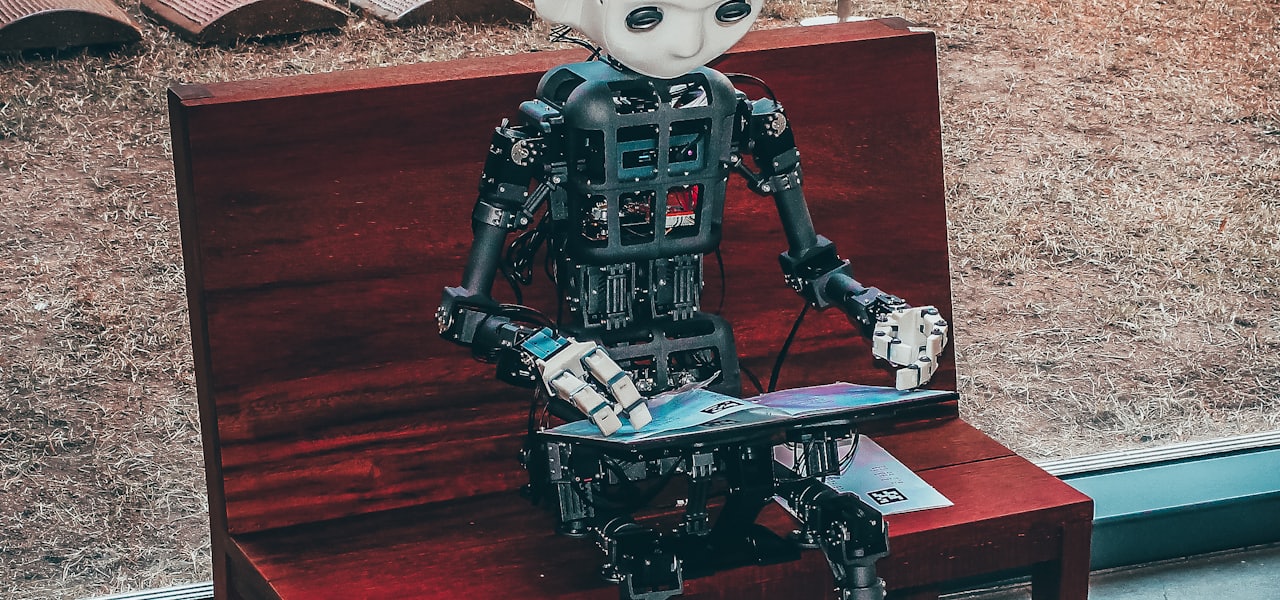
In artificial intelligence, apprenticeship learning (or learning from demonstration or imitation learning) is the process of learning by observing an expert. It can be viewed as a form of supervised learning, where the training dataset consists of task executions by a demonstration teacher. == Mapping function approach == Mapping methods try to mimic the expert by forming a direct mapping either from states to actions, or from states to reward values. For example, in 2002 researchers used such an approach to teach an AIBO robot basic soccer skills. === Inverse reinforcement learning approach === Inverse reinforcement learning (IRL) is the process of deriving a reward function from observed behavior. While ordinary "reinforcement learning" involves using rewards and punishments to learn behavior, in IRL the direction is reversed, and a robot observes a person's behavior to figure out what goal that behavior seems to be trying to achieve. The IRL problem can be defined as: Given 1) measurements of an agent's behaviour over time, in a variety of circumstances; 2) measurements of the sensory inputs to that agent; 3) a model of the physical environment (including the agent's body): Determine the reward function that the agent is optimizing. IRL researcher Stuart J. Russell proposes that IRL might be used to observe humans and attempt to codify their complex "ethical values", in an effort to create "ethical robots" that might someday know "not to cook your cat" without needing to be explicitly told. The scenario can be modeled as a "cooperative inverse reinforcement learning game", where a "person" player and a "robot" player cooperate to secure the person's implicit goals, despite these goals not being explicitly known by either the person nor the robot. In 2017, OpenAI and DeepMind applied deep learning to the cooperative inverse reinforcement learning in simple domains such as Atari games and straightforward robot tasks such as backflips. The human role was limited to answering queries from the robot as to which of two different actions were preferred. The researchers found evidence that the techniques may be economically scalable to modern systems. Apprenticeship via inverse reinforcement learning (AIRP) was developed by in 2004 Pieter Abbeel, Professor in Berkeley's EECS department, and Andrew Ng, Associate Professor in Stanford University's Computer Science Department. AIRP deals with "Markov decision process where we are not explicitly given a reward function, but where instead we can observe an expert demonstrating the task that we want to learn to perform". AIRP has been used to model reward functions of highly dynamic scenarios where there is no obvious reward function intuitively. Take the task of driving for example, there are many different objectives working simultaneously - such as maintaining safe following distance, a good speed, not changing lanes too often, etc. This task, may seem easy at first glance, but a trivial reward function may not converge to the policy wanted. One domain where AIRP has been used extensively is helicopter control. While simple trajectories can be intuitively derived, complicated tasks like aerobatics for shows has been successful. These include aerobatic maneuvers like - in-place flips, in-place rolls, loops, hurricanes and even auto-rotation landings. This work was developed by Pieter Abbeel, Adam Coates, and Andrew Ng - "Autonomous Helicopter Aerobatics through Apprenticeship Learning" === System model approach === System models try to mimic the expert by modeling world dynamics. == Plan approach == The system learns rules to associate preconditions and postconditions with each action. In one 1994 demonstration, a humanoid learns a generalized plan from only two demonstrations of a repetitive ball collection task. == Example == Learning from demonstration is often explained from a perspective that the working Robot-control-system is available and the human-demonstrator is using it. And indeed, if the software works, the Human operator takes the robot-arm, makes a move with it, and the robot will reproduce the action later. For example, he teaches the robot-arm how to put a cup under a coffeemaker and press the start-button. In the replay phase, the robot is imitating this behavior 1:1. But that is not how the system works internally; it is only what the audience can observe. In reality, Learning from demonstration is much more complex. One of the first works on learning by robot apprentices (anthropomorphic robots learning by imitation) was Adrian Stoica's PhD thesis in 1995. In 1997, robotics expert Stefan Schaal was working on the Sarcos robot-arm. The goal was simple: solve the pendulum swingup task. The robot itself can execute a movement, and as a result, the pendulum is moving. The problem is, that it is unclear what actions will result into which movement. It is an Optimal control-problem which can be described with mathematical formulas but is hard to solve. The idea from Schaal was, not to use a Brute-force solver but record the movements of a human-demonstration. The angle of the pendulum is logged over three seconds at the y-axis. This results into a diagram which produces a pattern. In computer animation, the principle is called spline animation. That means, on the x-axis the time is given, for example 0.5 seconds, 1.0 seconds, 1.5 seconds, while on the y-axis is the variable given. In most cases it's the position of an object. In the inverted pendulum it is the angle. The overall task consists of two parts: recording the angle over time and reproducing the recorded motion. The reproducing step is surprisingly simple. As an input we know, in which time step which angle the pendulum must have. Bringing the system to a state is called “Tracking control” or PID control. That means, we have a trajectory over time, and must find control actions to map the system to this trajectory. Other authors call the principle “steering behavior”, because the aim is to bring a robot to a given line.
Ameca (robot)
Ameca is a robotic humanoid created in 2021 by Engineered Arts, headquarters in Falmouth, Cornwall, United Kingdom. The project commenced in February 2021, and the first public demonstration was at the CES 2022 show in Las Vegas. Ameca's appearance features grey rubber skin on the face and hands, and is specifically designed to appear genderless. In 2024, an Ameca unit was installed in Edinburgh in the UK to reside at the National Robotarium. Ameca generation 3 has been released and showcased at ICRA 2025 along with Ami. == History == The first generation of Ameca was developed at Engineered Arts headquarters in Falmouth, Cornwall, United Kingdom. The project started in February 2021, with the first video revealed publicly on 1 December 2021. Ameca gained widespread attention on Twitter and TikTok ahead of its first public demonstration at the Consumer Electronics Show 2022, where it was covered by CNET and other news outlets. In 2022, Ameca presented an Alternative Christmas message by British TV Channel 4 for Christmas Day. Ameca was associated with the Museum of the Future's robotic family, where it could interact with visitors. In 2024, an Ameca unit was installed in Edinburgh in the UK to reside at the National Robotarium. In January 2026, Ameca served as an ambassador for the European Space Agency (ESA) at the 18th European Space Conference. == Features == It is designed as a platform for further developing robotics technologies involving human-robot interaction. utilizes embedded microphones, binocular eye mounted cameras, a chest camera and facial recognition software to interact with the public. Interactions can be governed by either OpenAI's GPT-3 or human telepresence. It also features articulated motorized arms, fingers, neck and facial features. Ameca's appearance features grey rubber skin on the face and hands, and is specifically designed to appear genderless. == Public appearances == Computer History Museum, California Heinz Nixdorf MuseumsForum, Paderborn, Germany Copernicus Science Center, Warsaw, Poland Museum of the Future, Dubai Consumer Electronics Show 2022 Deutsches Museum Nuremberg OMR Festival 2022 Hosted by Vodafone GITEX 2022 International Conference on Robotics and Automation 2023 International Telecommunication Union AI for Good Global Summit 2023 Sphere (Not Ameca, Custom humanoid named Aura built on Ameca technology)
Optical granulometry
Optical granulometry is the process of measuring the different grain sizes in a granular material, based on a photograph. Technology has been created to analyze a photograph and create statistics based on what the picture portrays. This information is vital in maintaining machinery in various trades worldwide. Mining companies can use optical granulometry to analyze inactive or moving rock to quantify the size of these fragments. Forestry companies can zero in on wood chip sizes without stopping the production process, and minimize sizing errors. With more photoanalysis technologies being produced, mining companies have shown an increased interest in these types of systems because of their ability to maintain efficiency throughout the mining process. Companies are saving millions of dollars annually because of this new technology, and are cutting back on maintenance costs on equipment. In order for optical granulometry to be completely successful, an accurate photo must be taken – under sufficient lighting, and using proper technology – to obtain quantified results. If these requirements are met, an image analysis system can be implemented. == The process == Software uses four basic steps in determining the average size of material: See the Wikipedia article on Photoanalysis to see how mining, forestry and agricultural companies are using this technology to improve quality control techniques. == Smartphone-based, segmentation-free estimation of grain size distribution == Recently, a methodology has emerged by which soil grain size distribution can be inferred from optical images acquired with commodity smartphones by training convolutional neural networks to predict parameters of the distribution curve directly from the image, without explicit image segmentation . In this approach, a standardized image of a soil surface is captured under controlled conditions, preprocessed to reduce device-specific variability, and passed to a regression model that outputs the parameters of a cumulative distribution function e.g., a two-parameter Weibull curve. The resulting distribution can be used to derive geotechnical descriptors and class boundaries.
Anthrobotics
Anthrobotics is the science of developing and studying robots that are either entirely or in some way human-like. The term anthrobotics was originally coined by Mark Rosheim in a paper entitled "Design of An Omnidirectional Arm" presented at the IEEE International Conference on Robotics and Automation, May 13–18, 1990, pp. 2162–2167. Rosheim says he derived the term from "...Anthropomorphic and Robotics to distinguish the new generation of dexterous robots from its simple industrial robot forebears." The word gained wider recognition as a result of its use in the title of Rosheim's subsequent book Robot Evolution: The Development of Anthrobotics, which focussed on facsimiles of human physical and psychological skills and attributes. However, a wider definition of the term anthrobotics has been proposed, in which the meaning is derived from anthropology rather than anthropomorphic. This usage includes robots that respond to input in a human-like fashion, rather than simply mimicking human actions, thus theoretically being able to respond more flexibly or to adapt to unforeseen circumstances. This expanded definition also encompasses robots that are situated in social environments with the ability to respond to those environments appropriately, such as insect robots, robotic pets, and the like. Anthrobotics is now taught at some universities, encouraging students not only to design and build robots for environments beyond current industrial applications, but also to speculate on the future of robotics that are embedded in the world at large, as mobile phones and computers are today. In 2016 philosopher Luis de Miranda created the Anthrobotics Cluster at the University of Edinburgh "a platform of cross-disciplinary research that seeks to investigate some of the biggest questions that will need to be answered" on the relationship between humans, robots and intelligent systems and "a think tank on the social spread of robotics, and also how automation is part of the definition of what humans have always been". to explore the symbiotic relationship between humans and automated protocols.
Candid (app)
Candid was a mobile app for anonymous discussions. It used machine learning to create personalized newsfeeds of opinions and real conversations, and also for moderation and filtering. Users posted under pseudonyms such as "HyperMantis", "SincereGiraffe", "GroundedTurtle" and "ExuberantRaptor", that are unique for each thread. Founder and CEO Bindu Reddy said that she needed "a place to express myself and engage in discussions where ideas can be debated on their own merits instead of being used to attack me as a person", which Candid tried to solve by redirecting off-topic comments to their appropriate groups, removing spam and flagging negative posts. They used natural language processing to identify hate speech, slander and threats, and removed them accordingly with human intervention. Candid software analyzed topics and tried to flag rumors and lies as such. Users could flag problematic posts and a team of ten contractors would review them individually. With time the system analyzed a user's interactions and give them labels, such as socializer, explorer, positive, influencer, hater, gossip, etc. In June 2017, Candid announced that it would be shut down because its parent company, Post Intelligence, was being acquired. The app was forecast to close on June 23, 2017, but didn't actually close until June 25, 2017.
Foundry VTT
Foundry Virtual Tabletop, commonly shortened to Foundry VTT or FVTT, is a commercial, self-hosted virtual tabletop application for role-playing games. It provides a stage for visualizing the game environment and tools allowing the game master and players to organize and track statistics and notes. The software is highly modular and depends on the community-maintained ecosystem of add-on modules that modify the software's behavior and implement different game systems. Perpetual licenses, which include updates, are offered for a one-time fee. == Features == Foundry Virtual Tabletop is a highly modular Node.js web application that is run locally by the Gamemaster or hosted on a remote server. Players connect to their gamemaster's Foundry VTT instance over the network using their web browser. It is system-agnostic in that its core feature-set is not restricted to a specific game system. Systems, specific features and game content are implemented as add-on modules, which can be individually downloaded from a public repository. The module repository contains paid, official content, as well as freely available community-made modules that enhance functionality of the software. As of May 2025, 350 individual game systems are implemented as modules. Individual settings created by the Game Master are termed Worlds in the interface and contain the list of modules that should be loaded as well as world-specific content, which can be added by the gamemaster. This content is grouped into Scenes, Actors, Items and Journals. Battle and world maps are created as Scenes, which contain the backdrop and data on placement of walls, light sources and other entities. Tokens representing Actors, which are player characters, vehicles or NPCs, can be placed on these Scenes to be moved by the user that owns them. Other entities that interact or integrate with actors are termed Items; these can be objects, but also game system-specific concepts such as character classes. Journals are text documents that can link to other entities present in the World or modules. Viewing and editing permissions can be set individually for each entity. The software features a custom lighting engine that determines visibility of certain areas on each battle map depending on the position of players' characters, also revealing areas covered by fog of war. It also contains tools for map creation and comes with a small asset library. == History == Foundry Gaming LLC founder Andrew Clayton, commonly known under his online nickname Atropos, began development of Foundry VTT in 2018 for personal use after becoming dissatisfied with the feature set and business models of other virtual tabletops. Foundry VTT was initially developed for Linux, which remains its primary platform, with support for other platforms having been developed later. Foundry Gaming LLC was incorporated in Spokane, Washington on October 9, 2018, with the software remaining in private beta-testing until May 2020, when it was publicly released. In November 2020, Cubicle 7 partnered with Foundry to bring official content modules for its game system Warhammer Fantasy Roleplay to Foundry VTT. Later, in 2025, Clayton would state that this first major publisher deal was of significant importance to Foundry VTT's growth and credits the community developers of the WFRP system module for making it possible in the first place. In November 2023, Paizo partnered with Foundry to bring official content modules for Pathfinder Roleplaying Game to Foundry VTT. In January 2024, Foundry publicly announced its partnership with Wizards of the Coast in bringing official Dungeons & Dragons content to Foundry VTT, with the first official module, Phandelver and Below: The Shattered Obelisk, having been released in February 2024. == Development == As of 2023, the Foundry VTT software itself is being developed and managed by a team of 9 people, while a content team of 12 people is working with partnered publishers to compile content into downloadable modules. The content team also develops in-house content published by Foundry Gaming LLC. Stated goals are to create a virtual tabletop software that offers a one-time purchase and content ownership, make use of modern web technologies, and provide a platform for developers to build upon. Clayton has stated that integration of Generative AI into Foundry VTT is not planned, citing ethical and legal concerns and calling its usage within the industry a "betrayal of the creative people who made the TTRPG industry what it is in the first place". == Reception == Foundry VTT is one of the most popular virtual tabletops for TTRPGs; in particular, as a self-hosted web-based VTT, it is known as a modern alternative to the software as a service Roll20. Wargamer named it one of the three "best virtual tabletops for D&D in 2023", noting its active community and high degree of technical complexity, which allows for customization not seen in other products at the cost of a much steeper learning curve. Comic Book Resources called it an "underrated gem" and "incredibly versatile" for similar reasons, while also praising its lighting engine and visual fidelity. As the previously mentioned outlets do, Foundry's modular ecosystem and technical implementation are often mentioned as good features, but also as a source of frustration for new users. In a video interview, Clayton acknowledges this issue and affirms that the development team intends to make usage of more technical features "friction-less" and will reduce module breakage between updates in the future.
Bin picking
Bin picking (also referred to as random bin picking) is a core problem in computer vision and robotics. The goal is to have a robot with sensors and cameras attached to it pick-up known objects with random poses out of a bin using a suction gripper, parallel gripper, or other kind of robot end effector. Early work on bin picking made use of Photometric Stereo in recovering the shapes of objects and to determine their orientation in space. Amazon previously held a competition focused on bin picking referred to as the "Amazon Picking Challenge", which was held from 2015 to 2017. The challenge tasked entrants with building their own robot hardware and software that could attempt simplified versions of the general task of picking and stowing items on shelves. The robots were scored by how many items were picked and stowed in a fixed amount of time. The first Amazon Robotics challenge was won by a team from TU Berlin in 2015, followed by a team from TU Delft and the Dutch company "Fizyr" in 2016. The last Amazon Robotics Challenge was won by the Australian Centre for Robotic Vision at Queensland University of Technology with their robot named Cartman. The Amazon Robotics/Picking Challenge was discontinued following the 2017 competition. Although there can be some overlap, bin picking is distinct from "each picking" and the bin packing problem.